
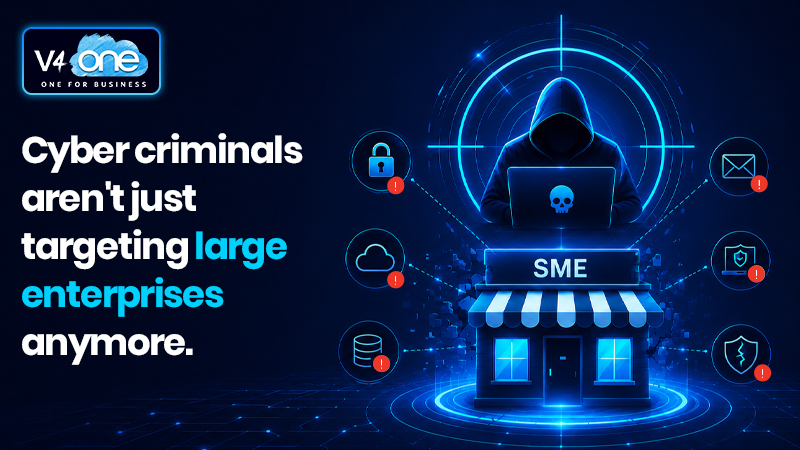
1. Assuming "We're Too Small to Be a Target"
One of the biggest misconceptions among SMEs is that hackers only target large corporations.
In reality, cyber criminals often see smaller businesses as easier opportunities. Automated attacks scan the internet continuously for vulnerable systems, regardless of company size.
Whether you're a 10-person business or a 200-person organisation, if your systems are connected to the internet, you're a potential target.
How to avoid it:
- Treat cyber security as a business priority.
- Carry out regular risk assessments.
- Invest in preventative security measures before an incident occurs.
2. Weak Password Policies
Despite years of advice, weak passwords remain one of the easiest ways for attackers to gain access.
Common issues include:
- Reusing passwords
- Using simple passwords
- Using shared accounts
- Never changing credentials
Password spraying and credential stuffing attacks remain highly effective because many businesses still rely on poor password practices.
Best practice:
- Use long, unique passwords.
- Implement password managers.
- Require Multi-Factor Authentication (MFA) across all critical systems.
3. Not Enabling Multi-Factor Authentication Everywhere
Many businesses have enabled MFA for Microsoft 365 but leave other critical services unprotected.
Cloud storage, VPNs, CRM systems, accounting software, and remote access platforms all need additional authentication.
Without MFA, a stolen password can be all an attacker needs.
Remember:
MFA dramatically reduces the likelihood of account compromise.
4. Ignoring Software Updates
Attackers are quick to exploit known vulnerabilities.
Unfortunately, many SMEs still delay:
- Windows updates
- Firmware updates
- Firewall patches
- Application updates
- Third-party software patches
Every missed update creates another opportunity for cyber criminals.
A proactive patch management strategy should include:
- Automated updates where appropriate
- Regular vulnerability scanning
- Monthly patch reviews
- Emergency patching for critical vulnerabilities
5. Believing Microsoft 365 Automatically Protects Everything
Many organisations assume Microsoft handles all aspects of security.
While Microsoft provides a secure platform, protecting your organisation is still your responsibility.
Businesses often overlook:
- Email security configuration
- Conditional Access policies
- Data retention
- Backup
- Identity protection
- User permissions
Cloud security operates under a shared responsibility model.
6. Not Backing Up Business Data Properly
Backups remain one of the most effective defences against ransomware.
Yet many SMEs either:
- Never test backups
- Only back up locally
- Have incomplete backup coverage
- Don't include Microsoft 365 data
A backup that cannot be restored offers little value during a cyber incident.
Follow the 3-2-1 rule:
- Three copies of data
- Two different storage types
- One copy stored off-site or securely in the cloud
Regular restoration testing is equally important.
7. Underestimating Employee Cyber Awareness
Technology alone cannot stop phishing attacks.
Human error continues to account for a significant proportion of successful cyber breaches.
Employees should be trained to identify:
- Phishing emails
- Fake invoices
- QR code scams
- Business Email Compromise (BEC)
- Social engineering
- AI-generated phishing messages
Cyber awareness should be an ongoing programme rather than an annual exercise.
8. Giving Too Many Users Administrative Access
Many SMEs provide staff with administrator privileges simply because it's convenient.
Unfortunately, this significantly increases the damage attackers can cause if an account becomes compromised.
Following the Principle of Least Privilege ensures employees only have access to what they genuinely need.
This limits the spread of malware and reduces overall business risk.
9. Having No Cyber Incident Response Plan
Many businesses only consider what to do after an attack has happened.
Without an incident response plan, valuable time is lost deciding:
- Who is responsible?
- Which systems should be isolated?
- Who contacts customers?
- When should insurers be notified?
- When should regulators be informed?
Preparation dramatically reduces downtime during a real incident.
Every SME should have a documented cyber incident response plan that is reviewed and tested regularly.
10. Treating Cyber Security as a One-Off Project
Cyber security isn't something you install once and forget.
Threats evolve every day.
Businesses that were well protected two years ago may now have outdated policies, unsupported systems, or emerging vulnerabilities.
Effective cyber security requires continuous improvement through:
- Security monitoring
- Regular reviews
- Vulnerability assessments
- Employee training
- Policy updates
- Technology refreshes
Cyber resilience is an ongoing process, not a one-time purchase.
Building a More Secure Business in 2026
The cyber security landscape continues to evolve rapidly, but the fundamentals remain the same. Strong passwords, Multi-Factor Authentication, timely software updates, secure backups, employee awareness, and proactive monitoring still provide some of the strongest defences against modern cyber threats.
For SMEs, the challenge isn't simply keeping pace with attackers; it's building a security strategy that supports business growth while reducing risk. Working with an experienced managed IT and cyber security partner can help identify vulnerabilities, strengthen defences, and ensure your organisation remains resilient as threats evolve.
At V4One, we help businesses implement practical, scalable cyber security solutions tailored to their operational needs. From managed security services and Microsoft 365 protection to backup, disaster recovery, and employee cyber awareness, we work alongside organisations to reduce risk and protect what matters most.
Cyber security isn't just about preventing attacks; it's about enabling your business to operate with confidence.