
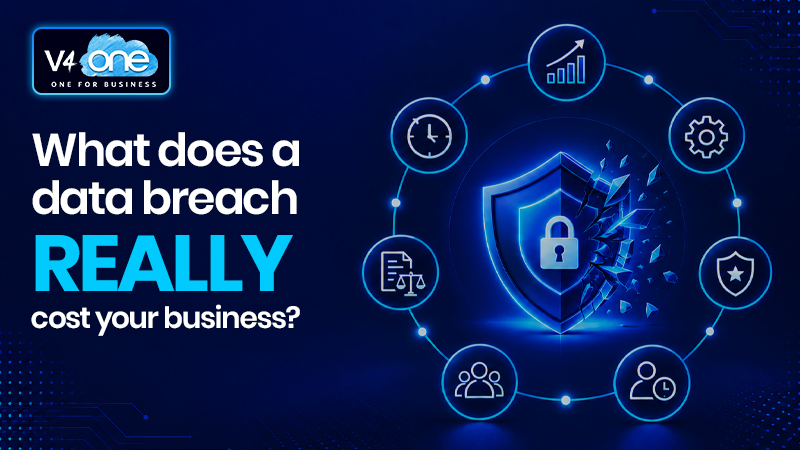
A data breach can start with something deceptively small.
An employee clicks a phishing link. A password is compromised. A device is left unsecured. Or a cybercriminal gains access to a single account.
But the cost of a data breach can be far greater than the money directly stolen.
For UK businesses, a serious breach can result in business interruption, lost revenue, regulatory consequences, recovery costs, reputational damage and lost customer trust.
And for many organisations, the true cost continues long after the initial incident has been contained.
So, how much does a data breach really cost a UK business?
The honest answer is: it depends.
The size and nature of the organisation, the data involved, how quickly the breach is identified and how effectively systems can be recovered can all make a significant difference.
Data Breaches Are Not Just a Cyber Security Problem
It is easy to think of a data breach as an IT issue.
In reality, it can quickly become a business-wide problem.
When systems, accounts or data are compromised, employees may be unable to work. Customers may be unable to access services. Orders may be delayed. Finance teams may have to stop normal processes.
Management may need to divert significant time and resources towards dealing with the incident.
The UK Government's Cyber Security Breaches Survey 2025/2026 found that 43% of businesses reported identifying a cyber security breach or attack in the previous 12 months.
Importantly, the same research shows that the financial impact varies considerably.
While many reported incidents had relatively low perceived costs, the highest-impact incidents created significant financial consequences.
Among businesses that experienced a breach or attack with an identifiable outcome, the median perceived cost was £560. However, the top 10% of incidents reached £10,000 and the top 5% reached £15,000.
These figures should not be viewed as a standard price tag for a data breach.
The important point is that the cost of an incident is rarely limited to what was initially lost or stolen.
1. Immediate Financial Losses
The most obvious cost of a breach is direct financial loss.
A cyber incident could result in:
- Money being stolen through cyber fraud
- Fraudulent payments or invoices
- Loss of access to business systems
- Costs associated with emergency IT support
- Specialist cyber security investigations
- Data recovery
- System restoration
- Legal advice
- Customer communications
- Additional security measures
For example, if an attacker compromises an employee's email account, they may monitor conversations before attempting to redirect payments or impersonate the employee.
The initial financial loss might be relatively straightforward to calculate.
The cost of investigating what happened, securing the account, checking other systems and ensuring the same attack cannot happen again is often much harder to quantify.
2. Business Interruption and Lost Productivity
One of the biggest costs of a cyber incident can be the work your employees are unable to do.
If systems are unavailable, staff may be unable to:
- Access customer records
- Process orders
- Raise invoices
- Access shared files
- Communicate with customers
- Access cloud applications
- Complete normal administrative tasks
Even if systems are unavailable for only a few hours, the cumulative productivity loss across an entire workforce can quickly become significant.
The latest Government survey found that additional staff time and implementing new measures to prevent future incidents were among the most common impacts reported by businesses experiencing breaches or attacks.
For larger organisations, the impact can be particularly substantial. The survey found that 30% of large businesses experiencing breaches or attacks required additional staff time to deal with them.
And the cost is not simply the hours spent fixing the problem.
It is also the work those employees would have been doing instead.
3. Lost Revenue
If your business cannot operate normally, revenue can suffer.
Customers may be unable to place orders. Projects may be delayed. Services may be unavailable. Employees may be unable to fulfil customer requirements.
The UK Government's 2025/2026 survey found that 5% of businesses experiencing a breach or attack reported a loss of revenue or share value, up from 2% in the previous year.
For an SME, even a relatively short period of disruption can have a noticeable effect on cash flow.
For a larger organisation, prolonged disruption can potentially mean millions of pounds in lost or delayed revenue.
This is why cyber security needs to be considered alongside business continuity and disaster recovery.
Preventing an attack is important.
Being able to continue operating when something goes wrong is equally important.
4. Regulatory and Legal Consequences
If a data breach involves personal information, there can also be regulatory implications.
Under the UK GDPR, organisations are required to implement appropriate technical and organisational measures to protect personal data.
Where a personal data breach is likely to result in a risk to individuals' rights and freedoms, organisations may need to report it to the Information Commissioner's Office (ICO) without undue delay and, where feasible, within 72 hours of becoming aware of it.
Depending on the circumstances, affected individuals may also need to be informed.
There can therefore be costs associated with:
- Investigating the breach
- Establishing what data was affected
- Legal advice
- Regulatory engagement
- Customer communications
- Remediation activities
- Strengthening security controls
Regulatory fines are not necessarily the biggest cost of a breach.
They are certainly not the only consequence businesses need to consider.
A serious breach can expose weaknesses in an organisation's wider data protection and cyber security processes.
5. Reputational Damage
Money can be recovered.
Trust is far harder to rebuild.
Customers expect businesses to protect their personal and commercial information.
If a company suffers a serious breach, customers may question whether their data is safe.
That can affect:
- Customer retention
- New business opportunities
- Contract renewals
- Supplier relationships
- Partnership opportunities
- Brand reputation
The latest Government survey found that 3% of businesses experiencing breaches or attacks reported reputational damage.
That percentage may seem small, but reputational damage can be difficult to measure because its effects often continue long after the technical incident has been resolved.
A customer who loses confidence in your ability to protect their information may not necessarily tell you why they choose another supplier.
6. The Cost of Putting Things Right
Once a breach has been contained, the work is not necessarily finished.
Businesses may need to invest in additional:
- Cyber security software
- Endpoint protection
- Multi-factor authentication
- Email security
- Network security
- Backup systems
- Monitoring solutions
- Staff training
- Cyber security assessments
- Penetration testing
- Security policies and procedures
These investments are positive if they strengthen your security posture.
However, they can still represent an unexpected expense when implemented reactively following an incident.
The Government's latest research found that 19% of businesses experiencing a breach or attack reported needing to implement new measures to prevent future incidents.
The lesson is simple: it is generally better to identify security gaps before a cybercriminal does.
7. The Hidden Cost: Management Time
One of the most overlooked costs of a data breach is senior management time.
During a serious incident, directors and business leaders may suddenly find themselves dealing with:
- IT teams
- Cyber security specialists
- Employees
- Customers
- Suppliers
- Insurers
- Legal advisers
- Regulators
- Communications teams
Instead of focusing on growth, customers and day-to-day operations, senior employees are focused on crisis management.
For SMEs in particular, where key responsibilities often sit with a relatively small number of people, this can have a disproportionate impact.
So, What Is the True Cost of a Data Breach?
There is no single figure that applies to every UK business.
The Government's latest research demonstrates just how widely the financial impact can vary.
Among businesses reporting an identifiable outcome from a breach or attack, the median perceived cost was £560, while the highest-impact incidents reported substantially larger costs.
Separate UK Government research examining significant cyber attacks estimated the average cost of a significant cyber attack for an individual UK business at almost £195,000.
This should not be treated as the expected cost of every breach, but it demonstrates the potential scale of serious incidents.
Ultimately, the true cost depends on what happens to your business when something goes wrong.
That is why simply asking, "How much would a breach cost us?" is not enough.
A better question is:
"How much could we lose if our critical systems, data or customer information were unavailable tomorrow?"
How Can UK Businesses Reduce the Cost of a Data Breach?
You cannot guarantee that your business will never experience a cyber attack.
You can, however, make attacks harder to succeed, identify incidents more quickly and improve your ability to recover.
Start with the fundamentals:
1. Protect Your Important Accounts
Use strong, unique passwords and enable multi-factor authentication wherever possible.
2. Keep Systems and Software Updated
Security vulnerabilities can provide attackers with opportunities to gain access to systems.
3. Protect Your Endpoints
Laptops, desktops and mobile devices can all become entry points for attackers. Make sure they are appropriately protected and managed.
4. Back Up Critical Data
Backups should be protected from the same threats that could compromise your primary systems. Just as importantly, regularly test that you can restore from them.
5. Train Your People
Your employees are a critical part of your security strategy. Regular cyber security awareness training can help them recognise phishing attempts, social engineering tactics and other common threats.
6. Monitor Your Environment
The faster you identify suspicious activity, the faster you can respond.
7. Have a Tested Incident Response Plan
When an incident happens, you do not want to be deciding who is responsible for what.
Your organisation should know:
- Who needs to be contacted
- Who has authority to make decisions
- How systems will be isolated
- How customers will be communicated with
- How critical systems will be restored
- What regulatory obligations may apply
And, importantly, test the plan regularly.
Prevention Is Cheaper Than Crisis Management
Cyber security should not simply be viewed as an IT expense.
It is an investment in the continuity, reputation and resilience of your business.
A strong cyber security strategy can reduce the likelihood of an attack succeeding while also helping your organisation respond more effectively when something does go wrong.
The most resilient organisations focus not only on prevention, but also on detection, recovery and continuous improvement.
Because the true cost of a data breach is not just the money you lose.
It is the business you cannot operate, the customers you might lose, the time your team spends dealing with the aftermath and the trust that can take years to rebuild.
Is Your Business Prepared for a Data Breach?
At V4One, we help UK businesses take a proactive approach to IT and cyber security, from protecting users and devices to securing networks, monitoring threats and preparing for disruption.
If your business experienced a data breach tomorrow, would you know exactly how to respond?
If the answer is "I'm not sure", now is the time to review your cyber security strategy, incident response planning and business resilience measures.
Talk to the V4One team about your IT and Cyber Security requirements and discover where your organisation could strengthen its resilience before an incident happens.
Technology Solutions. Experienced People. Personal Service.