
Dark Web Monitoring: Is Your Business Data at Risk?
Cybercriminals are constantly looking for ways to access valuable business information.
From stolen employee passwords and compromised email accounts to customer data exposed in security breaches, sensitive information can end up in the wrong hands without a business even realising.
The challenge is that your business data could be exposed long before you notice anything is wrong.
Information stolen during a cyberattack can be shared, traded or sold on the dark web, potentially creating opportunities for further attacks against your organisation.
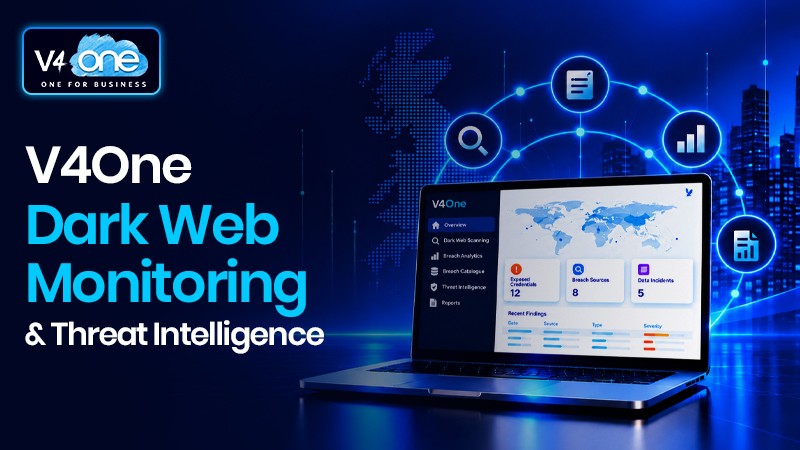
That's why V4One is introducing its new Dark Web Monitoring & Threat Intelligence Platform, helping businesses gain greater visibility of known data exposures and make more informed decisions about their cybersecurity.
What Is the Dark Web?
The dark web is a part of the internet that isn't accessible through standard search engines and typically requires specialised software or configurations to access.
Although it has legitimate uses, it is also used by cybercriminals to trade stolen information, including:
- Business email addresses and login credentials
- Passwords exposed in data breaches
- Customer and employee information
- Details obtained from compromised systems
- Information that could help criminals target an organisation
When business information appears in breach data or dark web intelligence sources, it can indicate that an account or organisation may be at risk.
For example, if an employee's business email address and password have been exposed in a previous breach, criminals may attempt to use those credentials to access company systems, particularly if the password has been reused.
The important thing to understand is that you don't necessarily need to experience a visible cyberattack for your information to be at risk.
What Is Dark Web Monitoring?
Dark web monitoring involves checking relevant sources of threat intelligence and known breach information for data associated with a business, its domain or its email addresses.
Rather than waiting for suspicious activity to become a serious incident, businesses can use monitoring to identify potential exposure and investigate whether action is needed.
Depending on the information available, a scan may identify associations with known breaches, including relevant dates, sources and other intelligence.
This can help businesses answer important questions:
- Have our business email addresses appeared in known data breaches?
- Could employee credentials be exposed?
- Is there information that warrants further investigation?
- What steps should we take to reduce the risk of unauthorised access?
Dark web monitoring is not a replacement for firewalls, endpoint protection, multi-factor authentication or other cybersecurity controls.
Instead, it provides an additional source of intelligence that can support a wider security strategy.
Introducing the V4One Dark Web Monitoring & Threat Intelligence Platform
At V4One, we understand that businesses need clear, practical information to make informed cybersecurity decisions.
Our new Dark Web Monitoring & Threat Intelligence Platform has been developed to help businesses investigate potential data exposure and better understand the risks associated with compromised information.
The platform brings together several useful capabilities.
1. Dark Web Scanning for Domains and Email Addresses
The platform allows users to scan a company domain or an individual email address for known exposure and breach information.
This can help highlight whether information associated with a business may have appeared in available breach intelligence.
For example, a business might want to investigate its corporate email domain or check an employee's business email address for known exposure.
Identifying a potential exposure provides an opportunity to investigate further, assess the risk and take appropriate action.
Importantly, a scan can only report on the information available to the platform.
A clean result does not guarantee that a business's information has never been compromised or is not present in undiscovered sources.
2. Detailed Breach Analytics
Finding a potential exposure is only the first step. Businesses also need to understand what the available information means.
V4One's platform provides breach analytics that can include:
- Available breach dates and timestamps
- Sources associated with identified exposures
- Related threat intelligence
- Details to help investigate potential risks
This information can help businesses build a clearer picture of known exposures and decide whether further investigation or security action is required.
For example, if an employee's email address appears in breach intelligence, the business may need to review password security, check for password reuse, assess account activity and ensure multi-factor authentication is enabled.
The appropriate response will depend on the information identified and the circumstances of the exposure.
3. A Catalogue of Known Breach Intelligence
The platform also provides visibility into the breach intelligence available through its catalogue, including incidents being tracked globally.
This helps users explore the wider breach landscape and understand the types of incidents represented within the available intelligence.
For businesses, this reinforces the importance of taking a proactive approach to cybersecurity.
Threats and exposures can arise from many sources, including compromised third-party services, employee accounts and historic data breaches.
4. Automated V4One Threat Intelligence Reports
One of the key features of the new platform is its automated, V4One-branded Threat Intelligence Report.
Once a scan has been completed, the user or V4One team can download a PDF report containing the scan findings.
The report provides a practical way to document and discuss identified exposures, helping businesses understand the results and consider their next steps.
It can also support conversations with organisations that want to understand their current cybersecurity position and whether additional protections may be appropriate.
Rather than relying on technical information alone, the report gives businesses a tangible starting point for a discussion about their potential exposure and the measures they could take to reduce risk.
Why Should Businesses Monitor the Dark Web?
Businesses of all sizes hold information that could be valuable to cybercriminals.
A company doesn't need to be a large enterprise to be affected by exposed credentials or compromised data.
Dark web monitoring can support several important areas of cybersecurity.
Identify Potential Exposure Earlier
Discovering that business information appears in known breach intelligence can prompt an organisation to investigate before the information is used in a further attack.
Reduce the Risk of Account Compromise
If credentials may have been exposed, businesses can review account activity, reset affected passwords where appropriate, revoke active sessions and strengthen authentication controls.
Support Better Cybersecurity Decisions
Threat intelligence can help businesses understand potential risks and prioritise appropriate security measures rather than relying on assumptions about their current level of protection.
Strengthen Existing Security Measures
Dark web monitoring works alongside other controls, including multi-factor authentication, endpoint protection, email security, employee awareness training and regular software updates.
Together, these measures can help businesses build a stronger and more resilient security environment.
What Should You Do If Your Business Data Is Exposed?
Discovering a potential exposure can be concerning, but it is important to respond methodically.
The right action depends on what information has been identified and whether there is evidence of unauthorised access.
Businesses should consider the following steps:
- Investigate the findings. Establish what information appears to be exposed, which accounts may be affected and what the available intelligence can confirm.
- Secure potentially affected accounts. Reset passwords where appropriate, eliminate password reuse, enable multi-factor authentication and revoke suspicious sessions or tokens.
- Review account activity. Look for unusual sign-ins, unexpected changes to permissions or other signs of possible compromise.
- Address any wider vulnerabilities. Check relevant systems, software and security controls to identify weaknesses that may need attention.
- Seek expert support where needed. An experienced IT or cybersecurity provider can help assess the findings, prioritise actions and determine whether further investigation is necessary.
Remember that a record in breach intelligence does not automatically mean an account is currently compromised.
The findings should be assessed in context, with action based on the risk identified.
Take a More Proactive Approach to Cybersecurity with V4One
Cybersecurity is not just about protecting your systems against threats that are already visible.
It is also about understanding potential weaknesses, investigating exposure and taking action to reduce risk.
V4One's new Dark Web Monitoring & Threat Intelligence Platform gives businesses another way to investigate known data exposure and turn threat intelligence into practical security conversations.
Whether you want to check a business domain, investigate an email address or better understand the risks facing your organisation, our team can help you explore the options available.
Could your business information be exposed without you knowing?
Get in touch with V4One to find out more about our Dark Web Monitoring & Threat Intelligence Platform and how it can support your wider cybersecurity strategy.
How Can V4One Help?
V4One provides managed IT and cybersecurity services to help businesses identify weaknesses, strengthen their defences and protect their technology.
Our new Dark Web Monitoring & Threat Intelligence Platform adds another way to investigate potential data exposure and support informed security decisions.
More content:
Could Your Business Be the Next Hacking Target? Why Cybersecurity Needs to Go Beyond Your Computers3 Simple Ways to Improve Your Business Cyber Security Without Spending Thousands
UK Cyber Security: The Key Threats and Lessons from September 2026
The True Cost of a Data Breach for UK Businesses
How to Build a Disaster Recovery Plan That Actually Works